When owners start asking whether to sell, step back, or keep going, there's often an earlier question underneath. How much does this business still depend on me? The answer shapes every option you have, whether you keep the business, step back from it, or sell it someday.
What people who see a lot of deals notice
I was recently in a conversation with people who see a lot of business sales. A familiar pattern came up. When a smaller business runs through the owner, buyers tend to lower what they'll pay or push more of the price into earnouts and terms. In other words, the owner who wanted out ends up tied to the outcome for longer.
That's their observation from the deal side, not a promise about any particular business. But it matches what I see from the operating side. The decisions, the relationships, and the judgment calls that still route through the owner are exactly what a buyer, a successor, or a leadership team can't yet rely on.
The seat, not the person
Here's the part of that conversation that stuck with me. In many owner-dependent businesses, someone on the team is ready to step up. They just haven't been handed the seat.
That's why I think of it as a seat problem first. The owner is still sitting in seats that someone else could own: approving the quote, settling the scheduling conflict, making the call on the customer exception. Each one feels faster to handle yourself. Over time, the business learns that the real decision lives with you.
The shift is from grinding to governing. Grinding means making the decisions. Governing means deciding who owns them, what good looks like, and how you'll know it's working.
Make the business boring
My goal for almost every business I work with is to make it boring.
Not dull. Boring. The kind of week where the work gets done as business as usual and nobody needs a fire drill to ship. Singles, hit so consistently that the next single starts to look like a home run.
Owners tend to remember the exciting weeks. The rescue, the late night, the big save. Those weeks feel like leadership. More often they're a sign the system didn't hold, and someone, often the owner, absorbed the gap.
A boring business is not one where nothing happens. It's one where what happens doesn't need a hero.
What maturity looks like
One of the clearer signals I've seen came from a leadership team in an owner-led practice I coach. In their quarterly session, they described a change: fewer big fires, more small fine-tuning issues.
That's a maturity signal. The temptation at that point is to meet less, because things feel calmer. The better move is to keep the cadence and change what the room works on: shift from firefighting to walking the full customer journey, looking for friction, and require one prioritized next action before the customer leaves.
Fine-tuning is what a team does when it owns the work. It's a sign the seats are filling.
Try this
You don't need to know whether you want to keep, step back, or sell to start here.
- List the five decisions that still wait for you.
- Next to each, write the name of the person closest to owning it.
- Circle the ones where the only missing piece is your permission.
- Pick one circled decision and hand over the seat, with a clear definition of what good looks like.
- Look at last month's wins. Which ones needed a hero? Pick one and ask what would make it routine.
The work that makes a business easier to own can also make it more transferable. You benefit even if you decide to keep it.
Which decision on your list is waiting on you, not on the person closest to owning it?
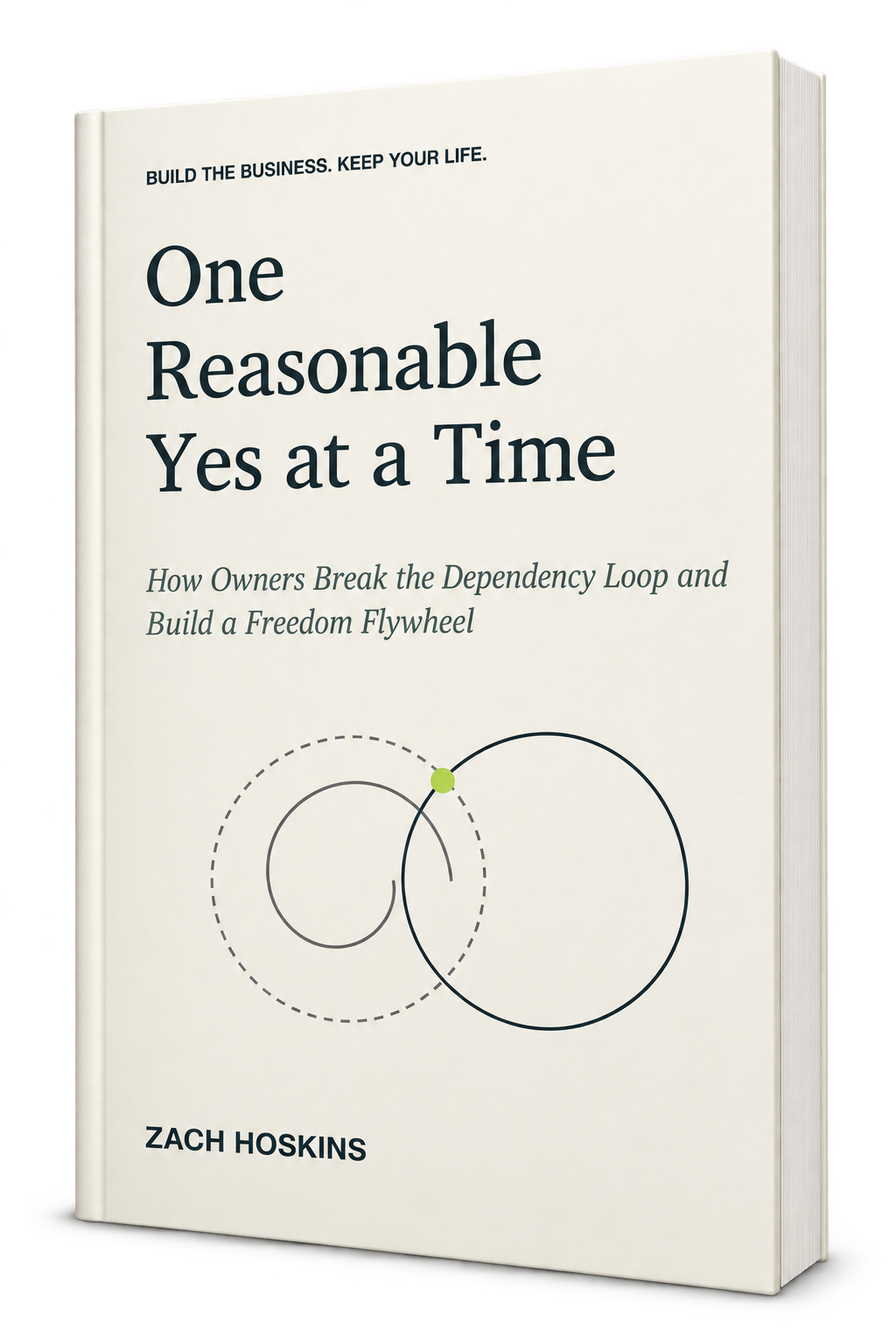
If you want to go deeper on how owners become the bottleneck and how to reverse it, get the free book, One Reasonable Yes at a Time.