Over the next five years, helping teams adopt change without fear will matter more than the AI tools themselves.
I sat in a conversation this week with an operator who has already built a successful platform after running EOS. We were talking about what working together might look like. The part that stuck was not a tool. It was the work of helping people move through change without freezing, and keeping a human in the loop for judgment and cross-silo thinking.
That matched what I am seeing inside the operating businesses I help lead. The useful AI work is not the flashy part. It is training a bot on last week's real send, watching the first draft match what a person already wrote, and still keeping a person on the send button. The proof is the match. The control stays with a human.
Tools are easy. Trust is the constraint.
Most owners I talk with can buy a tool in an afternoon. What slows them down is a team that has been burned by the last three "simple" changes, or a process that only works when the owner is in the middle of it.
Fear shows up as delay, quiet pushback, or workarounds that keep the old way alive. Cross-silo judgment is the other gap. A bot can draft a commission email or a pipeline review. It cannot tell you when two departments are solving different problems with the same data.
If you skip the human loop, you get faster drafts and slower trust.
What to do instead
Start where the change is small and the proof is obvious.
- Pick one recurring send or report the team already knows how to do by hand.
- Train the tool on last week's real version, not on a made-up example.
- When the first draft matches what you would have written, that is the proof it works.
- Keep a person on the send button. Drafts only until the team trusts the loop.
- Ask who is afraid of this change, and what would make the next step feel safer.
The goal is not more automation. The goal is a team that can take the next change without needing you to carry their fear.
Why this matters for your options
Whether you want to keep the business, step back, or someday sell it, you want a team that can adopt change without you being the only calm person in the room. Tools without that capacity just create a new dependency: you, explaining the tool, fixing the exceptions, and soothing the people who do not trust it yet.
A business that can adopt change without fear keeps getting easier to run. A business that needs the owner to sell every change stays heavy.
Try this
Pick one change you have been delaying because the team might resist it.
- What is the smallest version of that change that still creates a clear proof?
- Who needs to stay in the loop for judgment, not for typing?
- What would make the first week feel safer for the person who is most worried?
- If the first draft matched last week's real work, would that be enough proof to keep going?
If the honest answer is that only you can make the change stick, you have found a people-and-trust problem, not a tools problem.
Build the business. Keep your life.
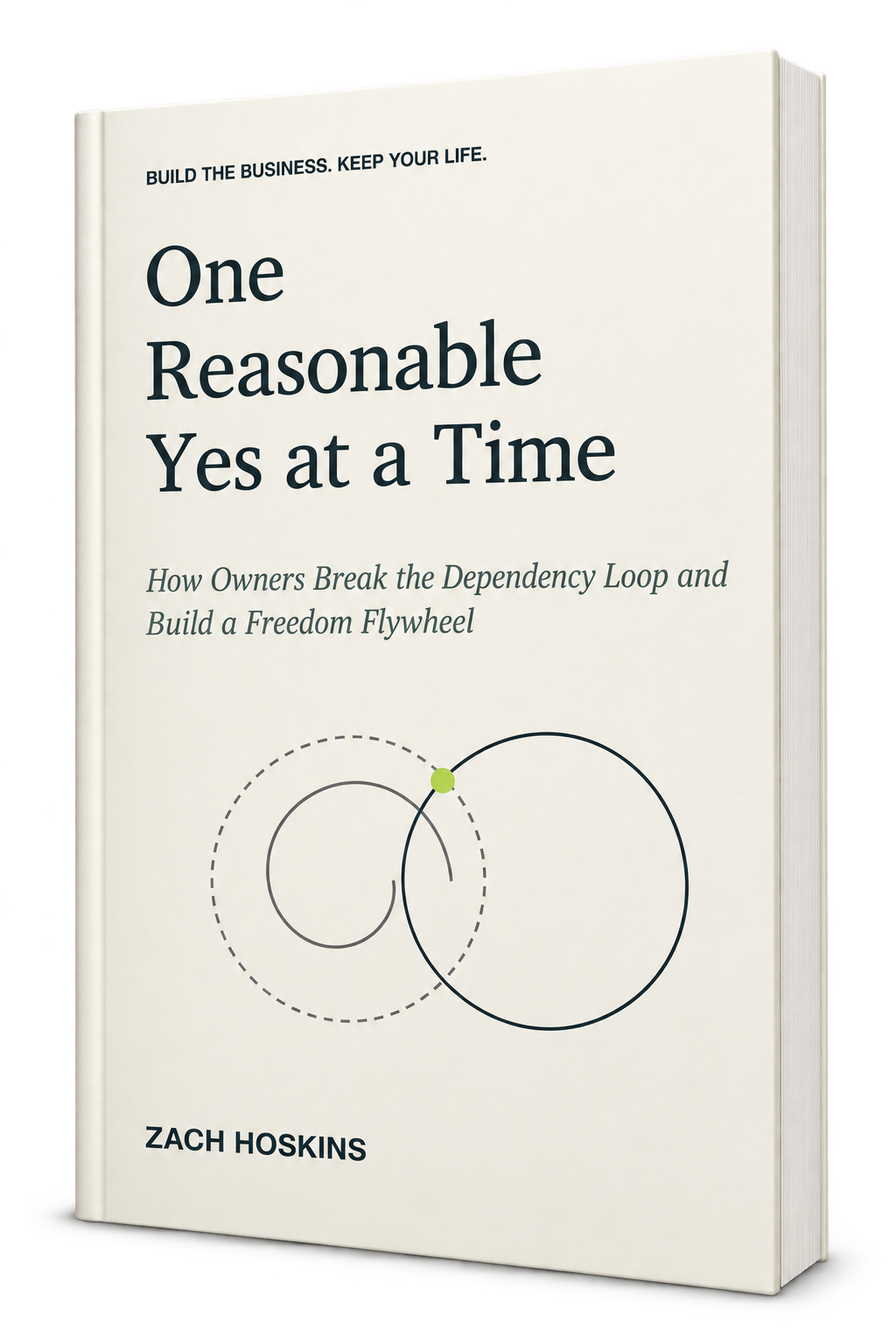
If you want the longer version of how owners get stuck in the middle of every decision and how to build a business that needs you less, get the free book, One Reasonable Yes at a Time.