Most owners I talk with have asked themselves some version of the same question: should I sell?
It's a fair question. But I've come to believe it usually shows up too late, and that there's a better one underneath it. How much does this business still need me?
The answer to that second question decides how many options you actually have when the first one gets serious.
One forced choice
Picture an owner whose business still runs through them. The big decisions wait for them. The key customer relationships sit with them. The numbers make sense only after they explain them.
That business can be very profitable. It can also be quietly narrowing the owner's options every year.
Because when something finally forces the question, an offer, a health scare, a partner who wants out, or simply being tired, that owner doesn't get to choose freely. Stepping back isn't really possible, because nobody else is ready to carry the load. Keeping it means more of the same. And selling means selling a business that depends on the one person who wants to leave.
That's not three choices. That's one forced choice dressed up as three.
Most owners can't name what their largest asset is worth
In a recent conversation with people who spend a lot of time around business sales, one observation stood out to me. For most owners, the business is the largest asset they have. They can tell you roughly what their house is worth and what's in their retirement account. Ask about the business, and most have no real idea.
I'm not a valuation firm, and I don't think every owner needs a formal number every year. But the point underneath it is important. It's hard to make good decisions about something you've never really looked at. And the thing most likely to shape what the business is worth, to you or anyone else, is how much of it still depends on you.
The work is the same whichever way you go
Here's what I find freeing about this.
The work that makes a business easier to own can also make it more transferable. You benefit even if you decide to keep it.
Clear seats. Leaders who own results without you in the middle. A scorecard the team runs without you. Decisions that have a home other than your inbox. None of that requires you to know today whether you'll keep the business for twenty more years, step back into a board-level role, or sell in five.
One owner I work with used to handle the financials personally. Now a team owns them, and the owner reviews the reports. That change didn't commit the owner to any exit. It created room. That's the shift from grinding to governing: from making every decision to deciding who owns each one and how you'll know it's working.
Another thing that came up in that same conversation: in most businesses past a certain size, someone on the team is ready to step up. They just haven't been handed the chance. That's not a hiring problem. It's an ownership problem, and the owner is usually the one holding the key.
Decide what you want before someone else decides for you
When I sit with an owner, I'd rather start with what they want the business to make possible than with what it might sell for.
How much is enough? Are you growing because the market is pulling you there, or because growth sounds like the right answer? What would you do with a month where the business didn't need you?
Those questions sound soft. They aren't. They tell you which work to do first. And the earlier you start, the more of the timeline is yours.
Keep it. Step back. Sell well. Each of those is a good outcome when you choose it. None of them is a good outcome when it's chosen for you.
Try this
You don't need to know your answer to start.
- Write down the three decisions that came to you last week that someone else could have made.
- Next to each, write the name of the person closest to owning it, and what they'd need from you to take it.
- Pick one relationship that only you hold. Plan how someone else will be in the room for it within 90 days.
- Ask yourself, honestly: if you couldn't be reached for a month, what would stall first?
- Write one sentence on what you want the business to make possible in five years. Not a number. A life.
Whatever you decide later, this work makes the decision yours.
Build the business. Keep your life.
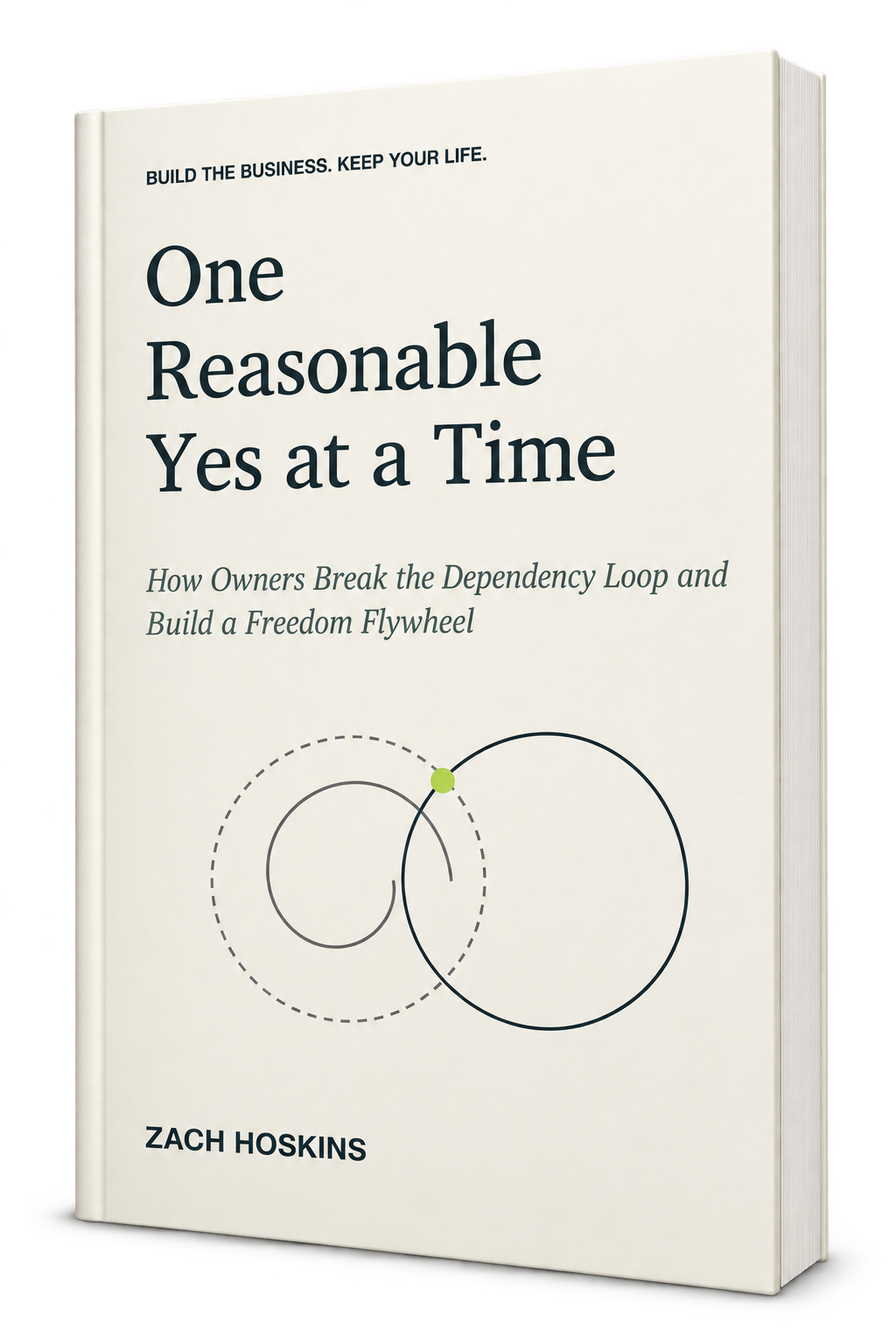
If you want the longer version of how owners become the bottleneck and how to reverse it, get the free book, One Reasonable Yes at a Time.