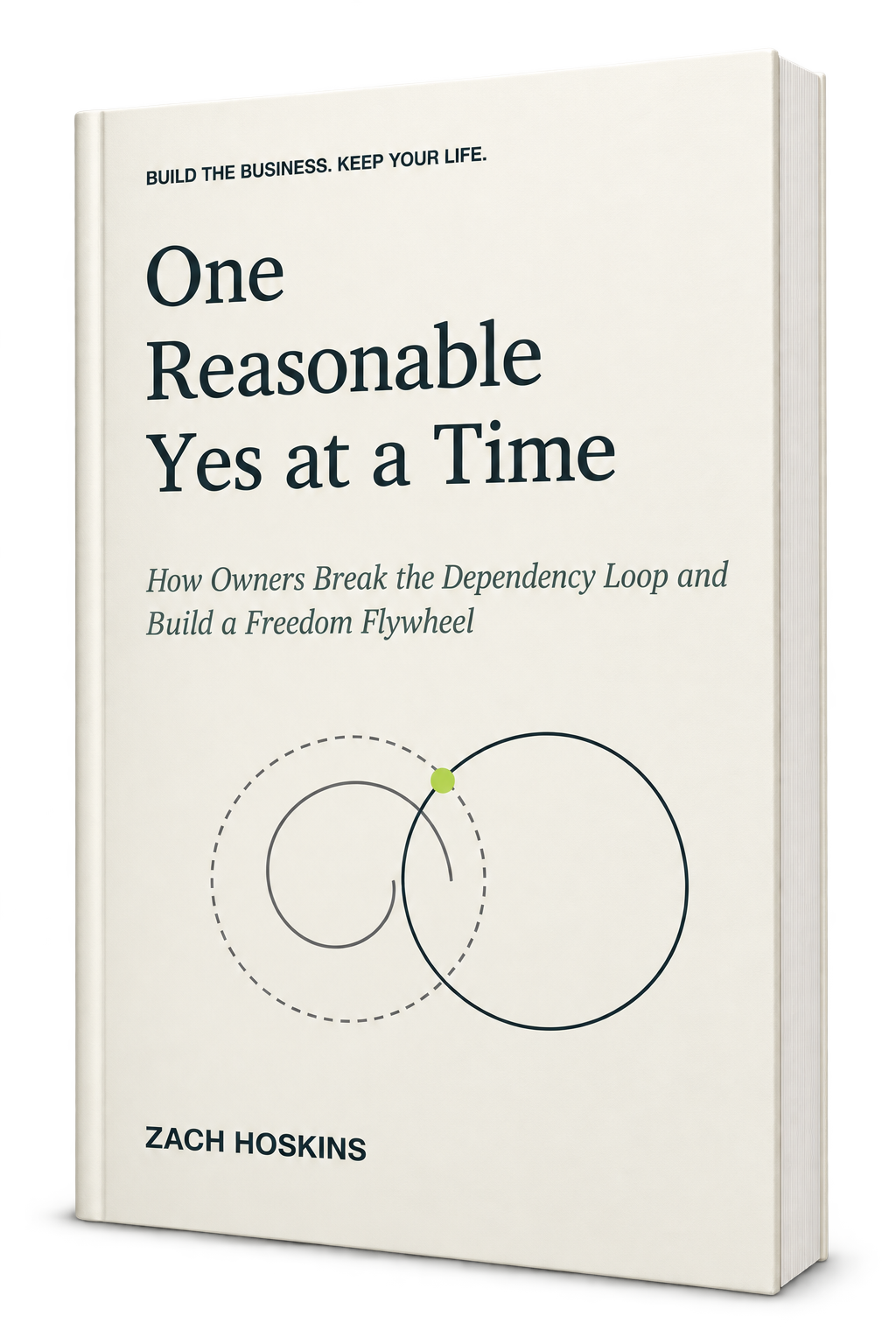
Most owner-operators I know did not set out to become the bottleneck.
They set out to build something that worked.
So they said yes.
Yes to the customer who needed an exception.
Yes to the hire who needed one more coaching conversation.
Yes to the decision that would have taken someone else three days and would take them twenty minutes.
Yes to the fire that only they could put out — this time.
None of those yeses were reckless.
That is the trap.
You become the bottleneck one reasonable yes at a time.
Default design
There is a design most businesses fall into without anyone choosing it.
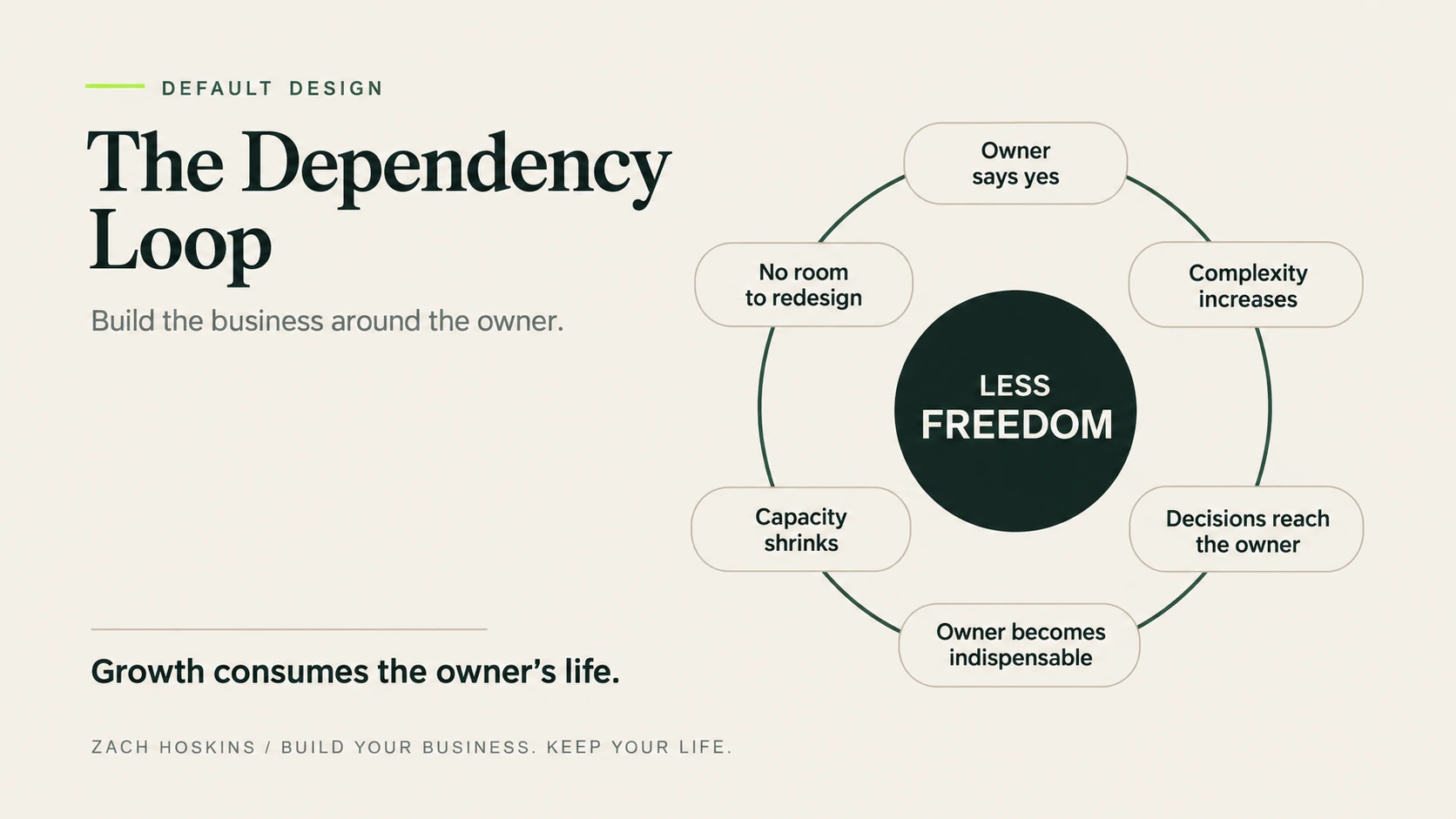
I call it the Dependency Loop.
It looks like this:
- Owner says yes — the reasonable exception, the shortcut, the “I’ll just handle it.”
- Complexity increases — more exceptions become the path; the path becomes the system.
- Decisions reach the owner — anything that matters still needs your eyes.
- Owner becomes indispensable — the business cannot move without you in the middle.
- Capacity shrinks — your calendar fills with other people’s urgency.
- No room to redesign — the work that would free you never fits between the fires.
- Less freedom — growth consumed the life you thought the growth would buy.
This is default design: build the business around the owner.
It feels like leadership while it is happening.
Presence feels like ownership.
Being needed feels like value.
Then one day you notice the pattern: if you can fix everything, everything finds you. And there is no room left to redesign the thing that made you indispensable.
That is how a business built for freedom starts eating the life.
The dangerous part is not any single step.
It is that each step makes the next one feel responsible.
Saying yes feels like service. Rising complexity feels like growth. Decisions reaching you feel like leadership. Becoming indispensable feels like security. Shrinking capacity feels like a busy season. Skipping redesign feels like you will get to it next month.
By the time freedom is gone, the Loop has a story for why every step was necessary.
That story is how default design hides inside good intentions.
The middle is where owner time dies
I have watched this in my own operating life and in rooms with other operators.
The first fifteen percent of a project — molding the shape — needs judgment.
The last five percent — closing, deciding, locking quality — needs judgment.
The middle eighty is where owners quietly die.
They stay because leaving the middle feels like neglect.
It is usually the opposite.
If your day does not create something that lifts the next thirty, it was a visit, not leverage. Presence without redesign is tourism with a title.
Heroics make this worse. Heroics look like culture. They are often a costume for a missing process. If the rescue team is the only reason output happens, you do not have a system. You have a dependency wearing a cape.
Enough is a design decision
Growth is not the villain.
Undesigned growth is.
Without a definition of enough — enough revenue, enough complexity, enough of you inside the machine — growth will choose for you. It will keep asking for more hours, more yeses, more of the one person who can still make it work.
Enough is a design decision.
Without it, the Dependency Loop is not a bug. It is the operating system.
The question I keep coming back to is simple:
If the company doubles and the design stays the same, does your life get twice as good — or do the current problems get twice as large?
That is the doubling test.
It is also the Loop, spoken as a future tense.
What intentional design looks like (without pretending you are finished)
I am not writing this from a mountaintop where the Loop is solved forever.
I am practicing the other design on purpose.
Intentional design starts in a different place: define the life, then design the business to produce it. Freedom is not a reward you collect after the company is “done.” It is a constraint you design through.
The alternative flywheel — define the life → design the business → build leverage → develop leaders → create optionality → reinvest in what matters — is the same ambition pointed at a different outcome.

Not less ambition.
Better-designed ambition.
Build your business. Keep your life.
Revenue is an output.
Freedom is the outcome.
Application — three moves this week
If you recognize yourself in the Loop, do not try to redesign the whole company on Friday night. Start where the Loop is fed.
1. Audit the reasonable yeses.
For seven days, write down every yes that only you could give. Not the dramatic fires — the twenty-minute ones. That list is the feedstock of indispensability.
2. Protect redesign time like a customer.
If redesign only happens in leftover hours, it will never happen. Empty hours after enough are optionality, not a vacancy to fill. Fill them with redesign before you fill them with another client.
3. Move judgment upstream; leave the middle.
Mold the first fifteen. Leave the eighty. Close the five. If you need the team to read your mind, you do not have a trust problem — you have an ownership problem dressed up as culture. Trust means they execute what you asked. Anticipation is a different job.
Name the constraint. Give it an owner. Then judge people against something they can actually move.
The Dependency Loop does not announce itself as a crisis.
It shows up as competence.
You are good at the middle. The business rewards you for staying there. Complexity increases. Decisions keep arriving. Capacity shrinks. Redesign never quite fits.
And one day the business you built for freedom is eating the life.
You become the bottleneck one reasonable yes at a time.
The way out is not working harder in the middle.
It is refusing to build the business around the owner by default — and designing, on purpose, around the life you actually want.
If this named something you have been living, the companion design is the Freedom Flywheel — define the life, then design the business to produce it.
I write about that more on X and at theefficiencyconductor.com.