Most owners I talk to have the same calendar.
Back-to-back meetings. Approvals stacked in between. A Saturday morning spent "just catching up." And underneath it all is a quiet belief: if I'm this busy, the business must need me.
It does. That's the problem.
You've built a real business and hired good people. Yet decisions still come back to you, commitments still need chasing, and a vacation means checking your phone by the pool. A full calendar feels like progress. More often, it's a sign the business has learned to run through you instead of without you.
Busy is not the same as valuable
Every quick approval and every "I'll just handle it" teaches the business one more thing it can't do without you. None of those moments feels like a mistake. Together, they build a company whose most important system is your availability.
That cost shows up in two places. It shows up in your life, because you can't step away. And it shows up in the value of the business, because a buyer, a lender, or a future partner sees exactly what you feel: too much of this depends on one person.
A business becomes more valuable, and creates more freedom, when it needs less of its owner to work.
Ask the question nobody has asked
A mentor of mine facilitates weekends for couples who own practices and companies. He told me about one couple where one spouse was the driver. Growth, scale, more capacity. The other was supportive, and clearly stretched.
He asked her one question: if we doubled this, would that feel like success for you?
She said no.
It wasn't an attack. It was clarity the plan had never made room for. And it didn't kill the ambition. They chose twelve months of steady, deliberate work, with a real decision point at the end. Grow later if it still makes sense.
A lot of growth plans are really the owner's current life, multiplied. Before you add the next big commitment, ask the people closest to you whether that bigger version is one they actually want to live in.
Try the carbon copy test
My friend Dustin told me about two questions a mentor once asked him. I haven't stopped thinking about them.
The first: what if next year were a carbon copy of this one? Would you be happy?
The second: what if it were the same year, but you only worked four days a week?
Most of us default to wanting more. More revenue, more growth, more on the plate. Very few owners start by asking whether this year already works, and what it would take to protect it. That question changes what you build. It points you toward leaders who own decisions, a scorecard that tells you the truth without a meeting, and a rhythm that keeps commitments moving when you're not in the room.
Fix the smallest thing that solves the real problem
When an owner finally decides the business needs to depend on them less, the instinct is often to throw everything at it. A full reorganization. A new software stack. An outside expert embedded for years.
Sometimes that's right. Usually it isn't.
The better rule is to use the lightest intervention that actually solves the problem. If you don't know what's really holding the business back, start with a diagnosis. If your team can execute but needs direction, a strong annual plan may be enough. If the plan keeps falling apart in the handoffs, you need an operating rhythm that lives inside your team. If you're facing a few high-stakes decisions, you need a thinking partner, not more meetings.
Whatever help you bring in should be designed to leave. Help that makes you dependent on the helper just moves the problem.
I've seen what's possible when this works. In one family business I worked alongside, the founders stepped back from daily operations within 6 to 12 months while the business kept growing. Not because they worked harder. Because authority, leadership, and systems moved to where they belonged.
Leave room on purpose
Here's the shift I'd invite you to make.
Stop treating an open hour on your calendar as a leak to plug. Treat it as evidence. Every hour the business runs well without you is proof it's becoming more valuable, and proof you're getting your life back.
This week, pick one thing you're about to handle out of habit. A decision your team could make. A meeting you don't need to run. A plan that assumes you'll carry it.
Hand it off on purpose. Then watch what happens in the space.
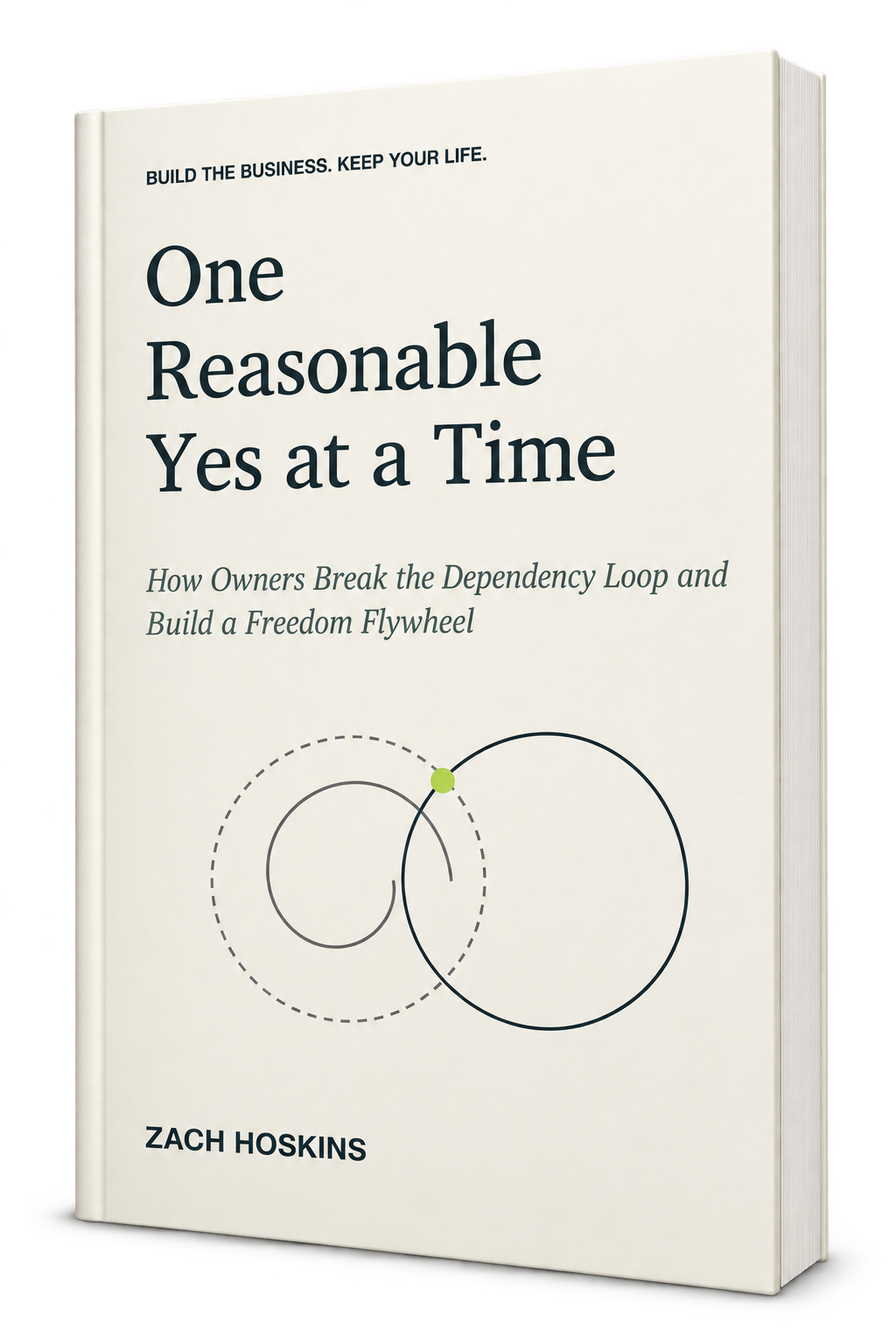
Build the business. Keep your life.
If too much of your business still depends on you, share what feels stuck. I'll help you find the lightest level of support that solves the real problem.